
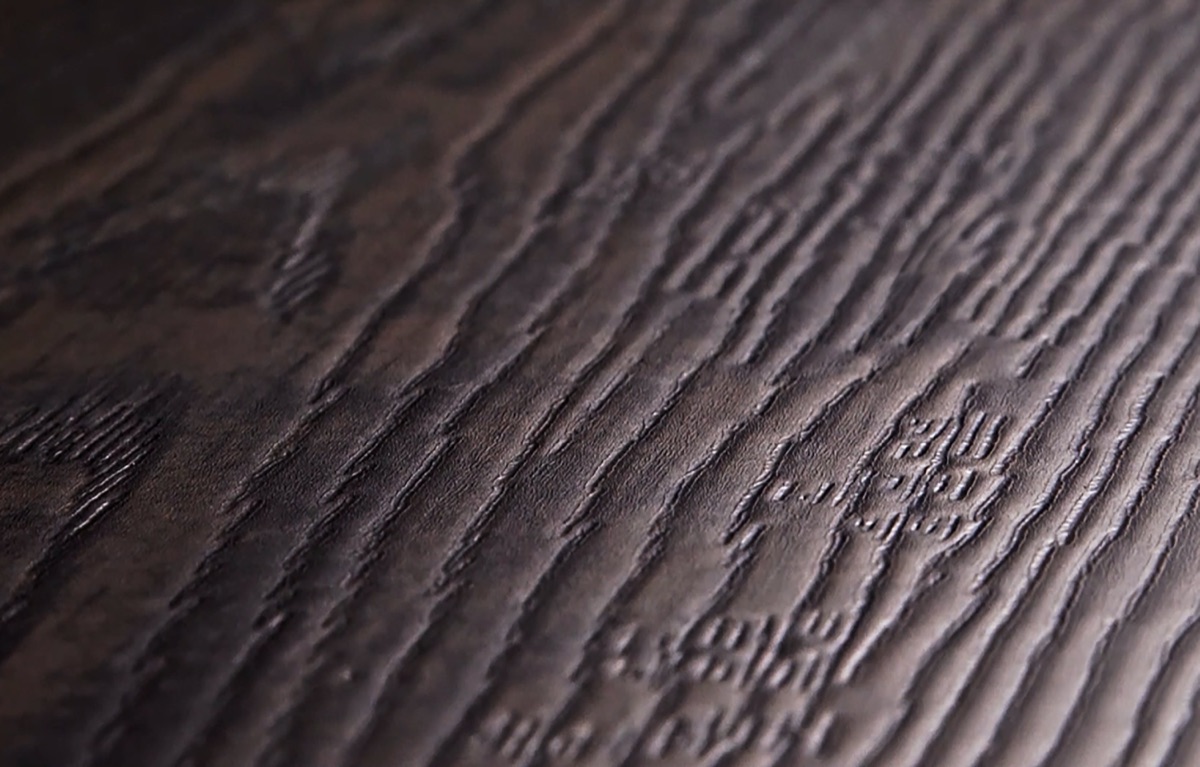
Walk across a conventional vinyl floor and something subtle feels off. The grain you see doesn’t match the texture you feel. That mismatch — print in one place, emboss in another — is the single largest reason budget flooring looks fake.
Benchwick’s DSE (Digital Synchronized Embossing) is our patented answer to that problem. It is the core of what makes every Benchwick plank look and feel like the material it imitates.
What DSE actually does
DSE combines positive and negative printing with a synchronized embossing press. The print head lays down the visual design, and an embossing roller — driven by the same digital source file — presses the texture in at the exact same coordinates. Ridges line up with knots, valleys with grain, fibers with vein lines.
- Positive and negative print passes for true 3D depth
- Texture-to-print alignment at micron precision
- Works across any pattern family: wood, stone, custom artwork
- Enhanced tactile experience versus traditional EIR (Embossed In Register)
Why it is a patent, not a spec
Traditional EIR flooring uses mechanical cylinders that roughly approximate the printed design. DSE uses a digital register loop: every embossing stroke is computed from the same source file that drove the 3D print pass. The result is not “close enough” — it is exact.
This digital register approach is what our patent protects. It is also why DSE can follow patterns with zero repeat, something mechanical embossing simply cannot do.
What it means for you
For architects and designers, DSE means the textures in your spec sheet are the textures that end up on the floor — no sample-to-reality drop-off. For homeowners, it means a floor that passes the hand test: you can feel a knot, and your fingers find exactly the detail your eyes are telling you is there.