
Flooring surface reviews often begin with an understandable reaction: a sample looks too busy, feels too flat or does not resemble the intended reference. Those impressions can start a useful discussion, but they are difficult for a manufacturing partner to act on unless the team explains what it observed and where.
For product developers and private-label teams, the goal is not to make every reviewer use technical language. It is to separate observations, connect them to a controlled reference and record the decision being requested. The workflow below is editorial coordination guidance. It is not a Benchwick testing protocol or a substitute for project-specific technical criteria agreed with qualified reviewers.
Define the decision before starting flooring surface reviews
Write one sentence describing the purpose of the session. The team may be choosing between visual directions, clarifying a texture preference or reviewing a revised reference. These are different decisions and should not be collapsed into an undefined request for final approval.
Identify the sample or reference set and its revision. Include who supplied it, the date and the relevant design identifier. If the reference is a proposal rather than an accepted target, say so clearly. Otherwise a reviewer may judge against a standard the project has never actually adopted.
List what is outside the session's scope. A visual discussion does not demonstrate wear performance, product suitability or certification. Keep those questions assigned to the appropriate review process instead of allowing a favorable appearance comment to stand in for unrelated evidence.
Keep printed appearance and tactile character distinct
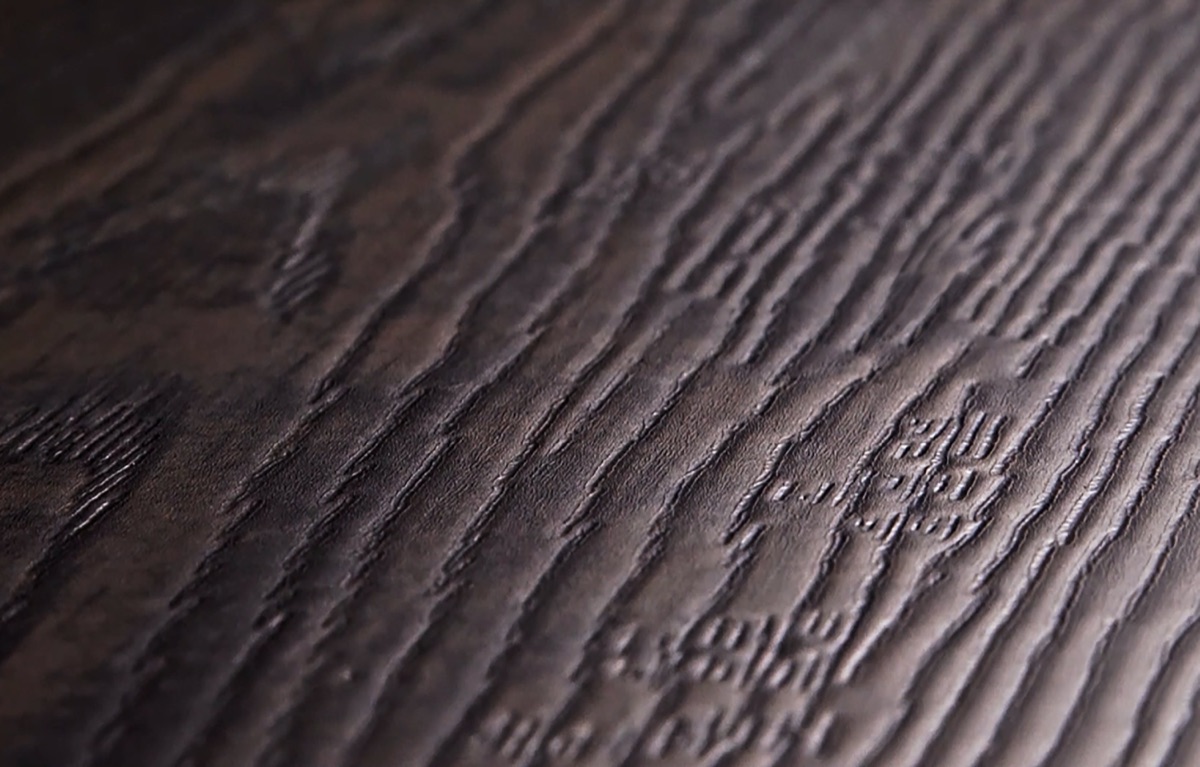
Benchwick's official innovation overview identifies Blue Eleven with digital printing and DSE with synchronized embossing. That distinction provides useful vocabulary for a development discussion: describe the visual design, describe the tactile impression and then ask how the two are intended to relate.
A reviewer might like the overall color direction but want to discuss the prominence of a grain feature. Another may accept the printed pattern while raising a question about the feel of a particular region. Record these as separate observations rather than summarizing both as “the surface is wrong.”
Avoid diagnosing a manufacturing cause from a short review. Describe the observed feature and ask the receiving team to assess it. An observation about appearance does not prove that a particular file, process or production setting caused it.
Use a comparison table to classify feedback
| Feedback category | Useful description | Reference to attach | Do not assume |
|---|---|---|---|
| Overall color direction | Which aspect differs from the agreed reference | Reference ID and review conditions | That an edited photograph is a color standard |
| Printed feature | The identified region and observed visual detail | Labeled crop linked to the full design | A specific manufacturing cause |
| Tactile character | Where and how the feel differs from the intended reference | Physical reference and location note | That a picture demonstrates feel |
| Print and texture relationship | The feature pair the team wants reviewed | Linked visual and physical references | An unagreed numerical tolerance |
| Decision status | Accepted direction, revision requested or information needed | Dated decision record and scope | Automatic release of production |
Control the reference before debating the result
Agree which physical reference is being used and who retains it. Record the viewing arrangement and any method the project has agreed to follow. This guide does not prescribe a universal light source, viewing distance or acceptance threshold; those belong in the project's qualified review plan.
If different reviewers are in different locations, document that limitation. A disagreement may be a reason to improve the review arrangement before requesting a product change. Do not silently average opinions gathered from unrelated screens, photographs or unlabeled samples.
Keep the current reference distinct from historical alternatives. When a target changes, give the new reference a clear identity and explain what it supersedes. A familiar sample left on a desk should not become an accidental competing instruction.
Describe a feature at both local and overall scale
Use a labeled region when commenting on a knot, grain line or other local feature. Link that view to the complete reference so the receiving team can locate it. A close crop without orientation may be difficult to relate to a full design.
Also record whether the concern changes the overall impression of the proposed surface. A feature noticed in a close view and a feature that dominates a broader arrangement are different discussion points. Explain the distinction without claiming that one photograph demonstrates a finished installation.
When several faces or references are included, identify which ones were reviewed. Do not generalize from one selected piece to an entire production range without the agreed evidence. State the scope of the observation so the manufacturer can respond proportionately.
Write feedback that leads to an answer
A useful feedback entry has an observation, a reference and a question. For example: the marked region appears more prominent than reference R2 under the documented review arrangement; can the team review this difference and advise what clarification is needed? That is more actionable than an instruction to make the design simply “more natural.”
Keep preferred outcomes separate from required outcomes. The team might request a softer visual impression while remaining open to the manufacturer's advice. If a feature is a fixed requirement, state the authority for that decision rather than expecting the recipient to infer its importance.
Assign one owner to consolidate comments. Preserve genuine disagreements in the record, but remove accidental duplicates and contradictory instructions before sending the review package. A consolidated question list should make the disagreement visible, not disguise it as agreement.
Record the scope of every response
When feedback returns, label the outcome precisely. Information received, direction accepted for further development and revision requested are not interchangeable statuses. Include the affected reference, decision owner and any remaining conditions.
If a revision is proposed, identify which observations it addresses and which remain open. Ask what additional review is needed before treating it as accepted. Keep earlier references accessible as history while clearly marking the active version.
Do not convert a positive appearance discussion into a production authorization without the agreed authority and process. Technical tests, commercial decisions and release controls may involve other participants. Each should remain traceable to its own evidence.
Make the next manufacturer discussion specific
Effective flooring surface reviews reduce ambiguity by separating color, printed detail, tactile character and decision status. They help a manufacturing partner understand the question without pretending that an informal review proves performance or identifies the cause of every difference.
Use Benchwick's product overview for program context and the company contact page to confirm the appropriate discussion route. Send a controlled reference list, a concise set of observations and the exact decision you need next. Keep the response connected to that same record as the development conversation continues.
Frequently asked questions
Why separate color comments from texture comments?
+
They describe different observations and may require different clarification. Separate entries help the receiving team understand whether a concern relates to printed appearance, tactile character or the relationship between them. Do not infer a manufacturing cause from the observation alone.
Can photographs replace a physical reference in surface review?
+
Photographs can identify a region or explain a question, but they do not convey tactile feel and can change apparent color with capture and display conditions. Agree with the manufacturer which physical reference and review method apply to the decision.
Should a team specify its own universal acceptance tolerance?
+
No. Agree the project-specific review method, measurements and acceptance criteria with the qualified parties before judging results. Do not import a tolerance from an unrelated program or invent a numerical threshold to make an informal observation appear conclusive.
Does accepting a visual direction release production?
+
Not automatically. Record the exact scope of the decision and who is authorized to make it. A preference for one visual direction, a sample decision and authorization for a later production step are distinct outcomes unless the agreed process explicitly connects them.